
Substack Library
GlossaryFeast, Famine & Policy
January 7, 2025The crucial question is: what is happening to consumer spending as a whole? Are auto sales symptomatic of consumer behavior, or will they be offset by reduced expenditures in other areas? We shall only know the answer when it is too late.
George Soros, The Alchemy of Finance, September 9, 1985
THIS IS NOT INVESTMENT ADVICE. INVESTING IS RISKY AND OFTEN PAINFUL. DO YOUR OWN RESEARCH.
We are in an economy, both nationally and internationally, that is feast or famine. If you are on the right side of the new technology coursing its way through the economy, money is flowing to you. If you are on the wrong side, money is flowing away from you, fast and painfully. Policy, particularly monetary policy, is a blunt instrument and can only be calibrated across the average of those on the winning and losing sides; what’s required for one group is deleterious for another.
This prism – feast or famine – explains much of what is going on around us. Below are examples.
1. National income. The wealth of countries closer to the boom—the US—and those that are more distant—Russia and North Korea but also Europe are sharply diverging. This feast or famine prism also explains the wealth shifts within an industry. To take one example, first Uber displaced taxi drivers, now driverless cars may displace Uber or perhaps Uber is able to collaborate with Waymo, which is controlled by Google. Or maybe both Google and Uber get whacked by Tesla’s self-driving cars. The process is relentless.
2. Debt. US corporate bankruptcies are at a 14-year high. US credit card defaults are at the highest level since 2010. Said differently, high interest rates are biting. Yet the big tech companies continue to spend aggressively. Why? Because their cash flows are so strong they don’t need to borrow. Effectively the sharply higher interest rates have no impact on their spending.
3. Household income. Below is a list that Bloomberg creates of billionaires. As you can see, the top ones are worth far more money than annual GDP of many countries. Musk’s net worth is more than Pakistan’s GDP. The way these people got there was by and large by taking huge, correct bets on technology.
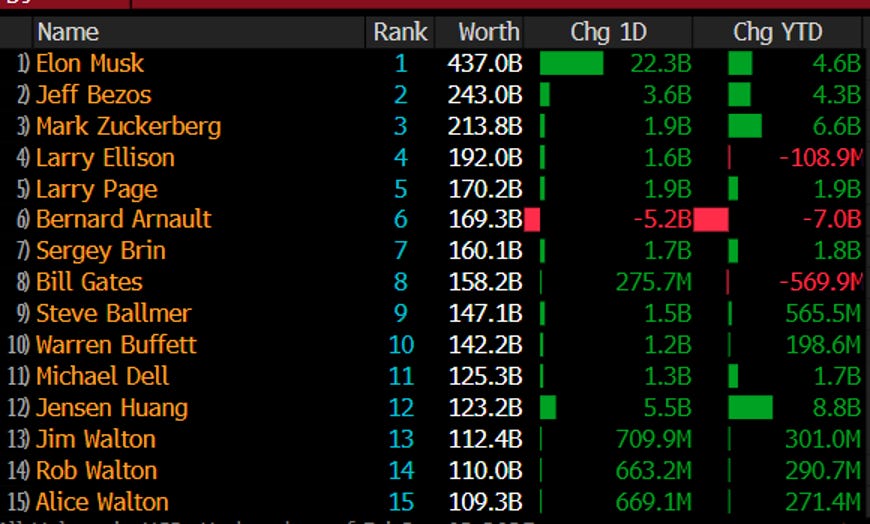
4. Politics. Seeing the above, people on the losing side of this tech shift are angry. Yes, these entrepreneurs walked through a valley of entrepreneurial uncertainty to get there. Still, the anger of the lumpenproletariat is understandable. It seems unfair, even if the benefits of this technology (Chat GPT is free) are widespread. In their anger, people vote to throw out whoever is in power, be that Democrats, Tories, the EU, centrist, or leftist. The problem is the politicians don’t have a solution. Stopping technology is like stopping gravity. The solutions they do propose, like Brexit or tariffs or seizing land or demonizing parts of the population are terrible ideas.
5. Turning inward. Tariffs raise prices and lower growth. There is a reason why people abandoned 19th-century policies, like the gold standard and tariffs. I find it notable Argentina is abandoning tariffs after their disastrous application at the same time the US is weeks away from introducing them. This policy is less rational than a “magic” solution to address the anger. Yes, China is a belligerent global power under Xi. But the real source of discontent is the very thing everyone spends all day looking at—their phones and the technology behind these phones. Next time you are in public, watch what percentage of people are on their phones versus looking around at others, talking or reading a book.
6. Geopolitical conflict. Ukraine’s ability to hold off a much larger army and the future of war itself is also a function of this feast-or-famine dynamic. While Ukraine is small and poor, they are on the right side of this new technology and thus able to hold off a much larger foe. To put numbers on it. Russia’s population is 142 million, Ukraine’s is 30 million. Russia’s GDP is around $1.7 trillion while Ukraine’s is $30 billion. The way Ukraine has done it is, yes, with Western aid, but also because they have been more inventive, paralyzing the Russian Navy with drones and inflicting massive casualties with the same technology.
7. Asset markets. The equity market is dominated by a few companies making a huge amount of money alongside other companies that make none. The “Mag 7” has daily free cash flow of about $1 billion. Meanwhile, 40% of the companies in the Russel 2k “small-cap” index are not profitable and the earnings yield on the S&P 500 index (1/PE) is less than the yield of a 10-year government bond. That’s not a buy signal.
This feast or famine dynamic is going to accelerate now that the government of the biggest economy in the world has been taken over by the people who are orchestrating the “feast,” Musk and his acolytes. They will adjust the rules to allow a faster rate of change. The average person, me and you, will scramble to find safety, to get ourselves onto the right side of the feast. It isn’t just us. Mark Zuckerberg scrapped moderation rules on Meta and appointed a Trumpee on the board for the same reason. We are all adapting as people have since the beginning of the Industrial Revolution, only this technology shift is happening at warp speed.
Where might this lead?
The bull case is that productivity is higher than the market expects and Elon is able to do to the Pentagon what SpaceX did to NASA – accomplish better results at a fraction the cost. That would drive government spending lower, narrowing the massive deficit, and could help counteract the inflationary impulse from tariffs. That’s bullish stocks and bonds.
The bear case is that Trump 2.0 is like Trump 1.0 and that there are different factions with no coherent vision, other than Trump’s firm belief in tariffs and his own infallibility. This can lead to very quickly rising long-term bond yields, yields that rise fast enough to hurt the stock market.
Recall the stock market fell sharply the last time Trump introduced tariffs. Earlier this week, a story appeared that Trump would apply tariffs selectively. Bonds and stocks promptly shot higher. Then Trump himself came out and said the report was false. The move reversed. That’s a clue. Likely the incoming administration itself doesn’t know the actual tariff policy and things will be decided in an unpredictable fashion.
The obvious policy choice is to reduce government spending modestly and tax those who benefit most from the tech shift and use those funds to further reduce the government deficit, which would lead to falling yields and a recovery in household borrowing. This would give households more room to navigate this disruptive technology shift. But policy proposals don’t look anything like that, which means disruptive outcomes are possible. There is a scenario where tariffs and tax cuts boost inflation, Trump’s behavior is erratic and the Fed can’t cut even if the economy is weakening. In that scenario, risky assets suffer.