
Substack Library
GlossaryA Wider Distribution
November 13, 2026Not investment advice.
Markets are moving in a skittish, volatile manner because key anchor points are shifting, and trillions of dollars of capital are being forced to adjust. Specifically, interest rates are moving above what investors thought was possible, and AI demand is moving below what investors thought was possible, despite hopes the bond sell-off was over and that tech stocks had merely wobbled.
Here are the salient points:
-
U.S. growth is not slowing (yet) because what I have referred to as the “cage fight for capital” (AI capex and U.S. government debt). This is producing fast, concentrated growth and slow, broad-based inflation. The Fed is now well behind the curve. What initially seemed like the removal of “insurance cuts” now looks like a full-fledged tightening. Inflation is stuck above 3 percent. Fed Governor Waller floated raising rates 50 bps at once1, which is appropriate in my view.
-
This inflation impulse is not isolated. The same thing is happening in Japan (though not so much in other countries). Below I show inflation in the U.S. and Japan.
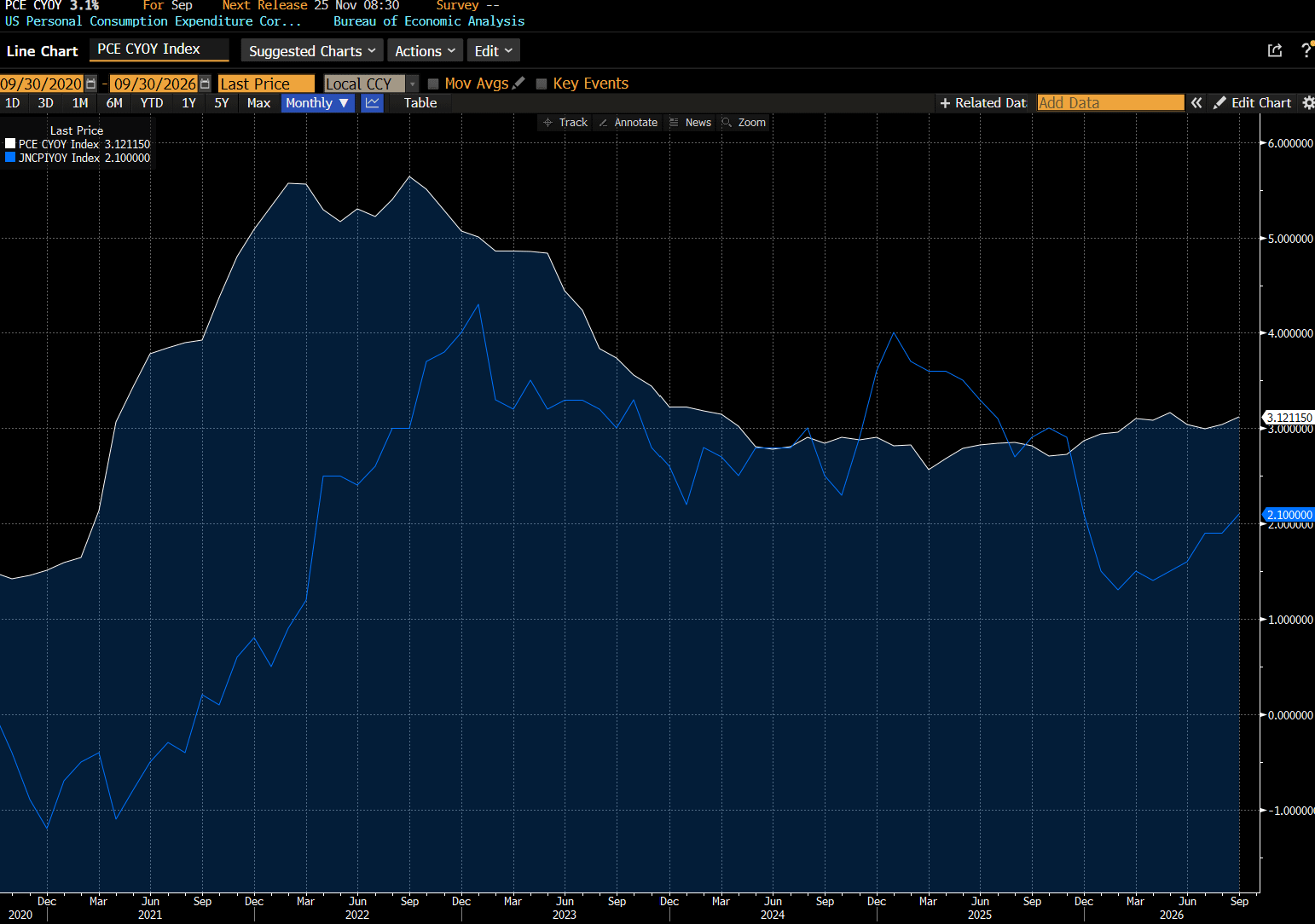
Source for this and subsequent charts: Bloomberg.
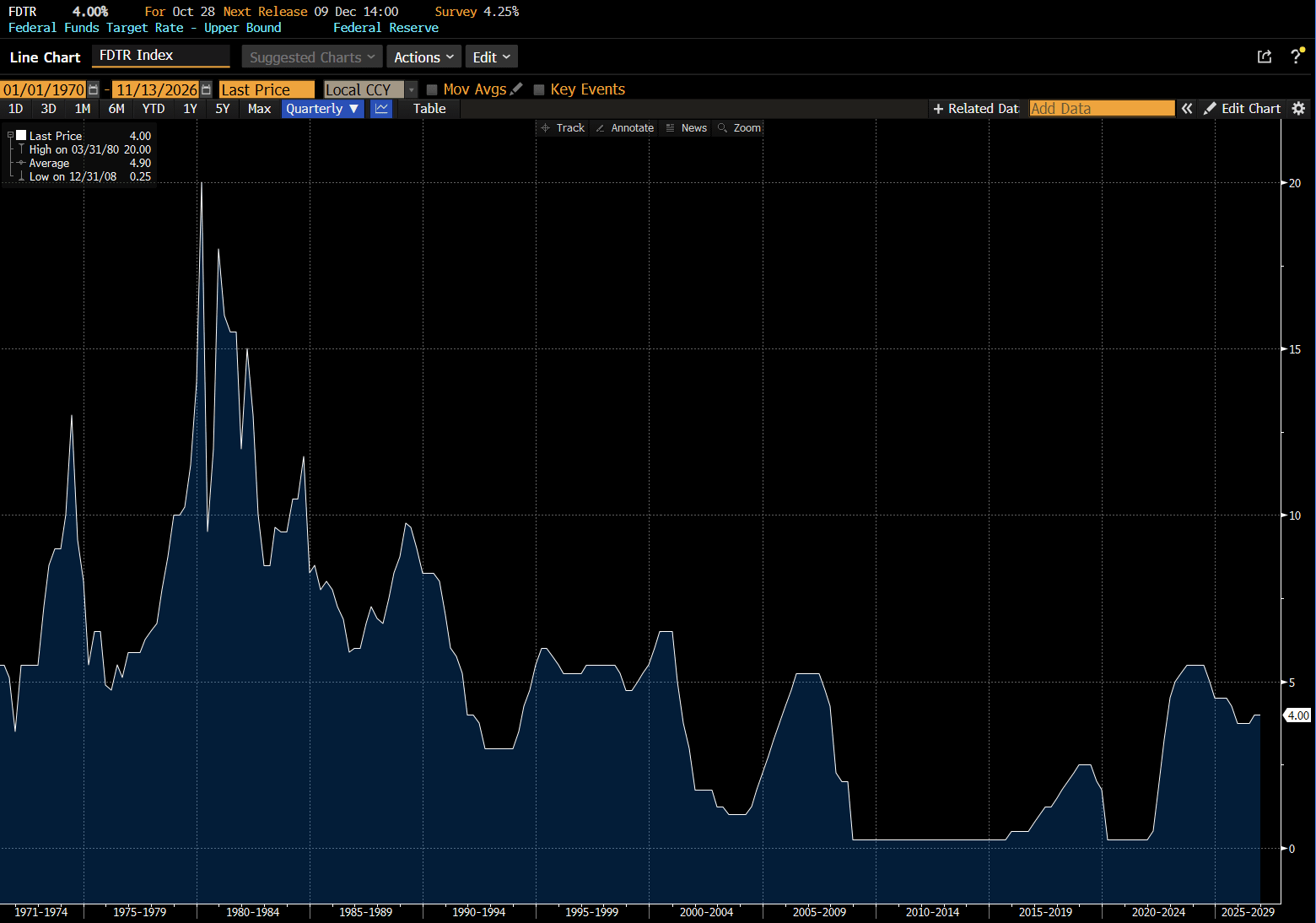
This means bond yields need to go higher. The consensus as priced into bond markets is that inflation will settle and fall. The Fed rate is currently at 4% and priced to rise to 4.75%, but a typical tightening cycle with inflation this high would move it closer to 6%. Similarly, in Japan, rates are supposed to top out at 2%, whereas before Japan hit their deflationary depression, a policy rate of 4% was more normal.
-
This inflation has created a meaningful swing in politics. Voters everywhere hate inflation. The Democrats know they cannot be associated with inflation and win the presidency in 2028. Fed officials are not elected, but they still represent “the people” and can see that the public is exasperated by inflation. Policy choices will be shaded toward reducing inflation. That is clearly hawkish monetary policy and will almost certainly slow data center growth, which is largely regulated at a local level.
-
Next week, Anthropic IPOs, and the IPO has been described as “oversubscribed.” The company will likely be cash flow negative for years and tens of billions of shares are eligible for sale on Thursday. If the stock starts to trade down, that’s a sign.
-
Jensen Huang lost his seat at NVDA. There are three key founders at the center of AI demand: Jensen, Elon Musk, and Mark Zuckerberg. Elon and Mark have products that use AI (rockets, cars and social media), but their key product is not AI hardware. Jensen’s product is the thing itself—the chips (really switches) that allow the matrix multiplication that makes AI work. He also used his balance sheet to lever up demand. NVDA total commitments are $530 billion, according to the Wall Street Journal. To put that into perspective, that is about the size of the total Tier 1 Capital of the largest US banks. A typical bank is levered 10 to 1, meaning every dollar of credit sponsors $10 of demand. What will the new leadership do at NVDA? My guess is shut down this lending, which is also bearish demand.
-
Finally, many of the models themselves are incredible, but most of us probably don’t need better models. We can barely keep up with what they already do. For instance, AI is woven into many processes at Kate; we are a small firm with no bureaucracy, and even we can’t incorporate the new models fast enough.
Taken together, it looks like central banks need to tighten significantly to stem the inflationary impulse, even as expectations embedded in stock prices are for a continued boom. In good times, an investor can be long stocks and bonds and make money. Sometimes only one asset works but the combo works. It’s rare that neither stocks nor bonds work, yet that is the environment we appear to be in.
This document is strictly confidential and is intended for authorized recipients of “A Letter from Paul” (the “Letter”) only. It includes personal opinions that are current as of the date of this Letter and does not represent the official positions of Kate Capital LLC (“Kate Capital”). This letter is presented for discussion purposes only and is not intended as investment advice, an offer, or solicitation with respect to the purchase or sale of any security. Any unauthorized copying, disclosure, or distribution of the material in this presentation is strictly forbidden without the express written consent of Paul Podolsky or Kate Capital LLC.
If an investment idea is discussed in the Letter, there is no guarantee that the investment objective will be achieved. Past performance is not indicative of future results, which may vary. Actual results may differ materially from those expressed or implied. Unless otherwise noted, the valuation of the specific investment opportunity contained within this presentation is based upon information and data available as of the date these materials were prepared.
An investment with Kate Capital is speculative and involves significant risks, including the potential loss of all or a substantial portion of invested capital, the potential use of leverage, and the lack of liquidity of an investment. Recipients should not assume that securities or any companies identified in this presentation, or otherwise related to the information in this presentation, are, have been or will be, investments held by accounts managed by Kate Capital or that investments in any such securities have been or will be profitable. Please refer to the Private Placement Memorandum, and Kate Capital’s Form ADV, available at www.advisorinfo.sec.gov, for important information about an investment with Kate Capital.
Any companies identified herein in which Kate Capital is invested do not represent all of the investments made or recommended for any account managed by Kate Capital. Certain information presented herein has been supplied by third parties, including management or agents of the underlying portfolio company. While Kate Capital believes such information to be accurate, it has relied upon such third parties to provide accurate information and has not independently verified such information.
The graphs, charts, and other visual aids are provided for informational purposes only. None of these graphs, charts, or visual aids can of themselves be used to make investment decisions. No representation is made that these will assist any person in making investment decisions and no graph, chart or other visual aid can capture all factors and variables required in making such decisions.
https://www.federalreserve.gov/newsevents/speech/waller20261110a.htm