Substack Library
GlossaryCracks Form
September 25, 2026Not investment advice.
A lot of small things are adding up to a potentially big thing—the mighty, seemingly indestructible US equity market is beginning to show fissures, even while it hit yearly highs early this week.
Here are the data points that are catching my attention.
-
Year-to-date, equity indexes are up over 12%, fueled by a rise in earnings. Earnings have been driven disproportionately by two sectors—energy and AI. Energy is due to the war and AI is due to strong demand, the marking up of illiquid investments in OpenAI and Anthropic, and the boost earnings get when there is a capex boom. PEs are down.
-
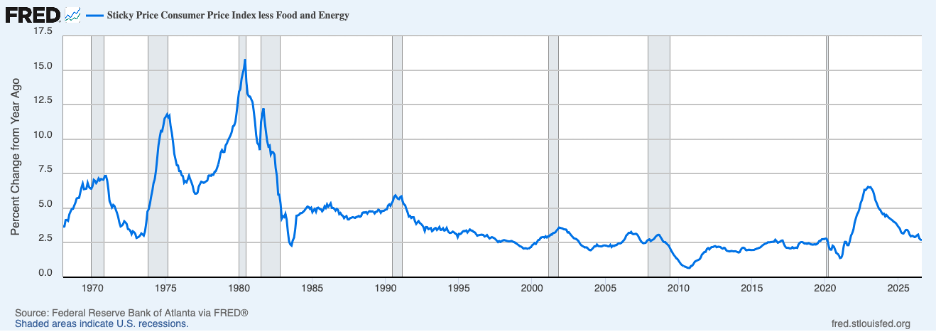
Bond yields have risen from about 4.15% to 5.15%, driving PEs down. This bond yield rise is due to a strong credit impulse, driven by government deficits and AI spending. The government deficits are not going away, though inflation (below) looks like it is gradually waning. Higher bond yields asphyxiate parts of the economy, like housing, meaning earnings are reliant on the AI boom to continue.
-
OpenAI, one of two providers of the leading models, delayed its IPO. Delayed is a diplomatic word; canceled might be more accurate. They said this was in part due to concerns over safety. Wall Street is wondering two things. First, if OpenAI hacks a target, who is liable? Is the argument the one gun makers use (it’s not the gun, it’s how you use it), or is it the one applied to carmakers (who are liable if the car is unsafe)? If OpenAI is liable, this opens the door to significant legal issues. Second, there is the question of how many frontier models the world needs. AI is already pretty smart. Go for a walk with Grok and Grok can speak to you with far more knowledge than any human. Is AI already good enough for most tasks? This raises questions about exactly how big the compute needs will be going forward.
-
There are numerous models of what exactly compute demand will be. Some are based on past productivity shocks. Some are based on analyzing the companies themselves. The short answer is that no one knows exactly how much compute we will need. A lot is a fair assumption, but a lot is already discounted in the price, so it needs to be more than a lot.
-
OpenAI has long-term contracts with key elements of the supply chain, like Nvidia and CoreWeave, who in turn have key relationships with companies like TSMC and ASML. If OpenAI is 15% of all compute demand (a rough estimate), what happens if that spending slows? Nvidia has traded sideways for quite some time. This would also explain why Nvidia’s CEO is adamant that regulation is unnecessary. On the other hand, the mistake so far has been to underestimate the magnitude of the boom.
-
The Democrats are favored to win the House and possibly even the Senate in six weeks. They have made regulating AI a part of their strategy. Should they perform as well as they are expected to, this may be a catalyst to accelerate AI regulation, though of course Washington moves slowly and the White House has said it does not want to regulate AI. Given the risk to the stock market, that’s logical.
-
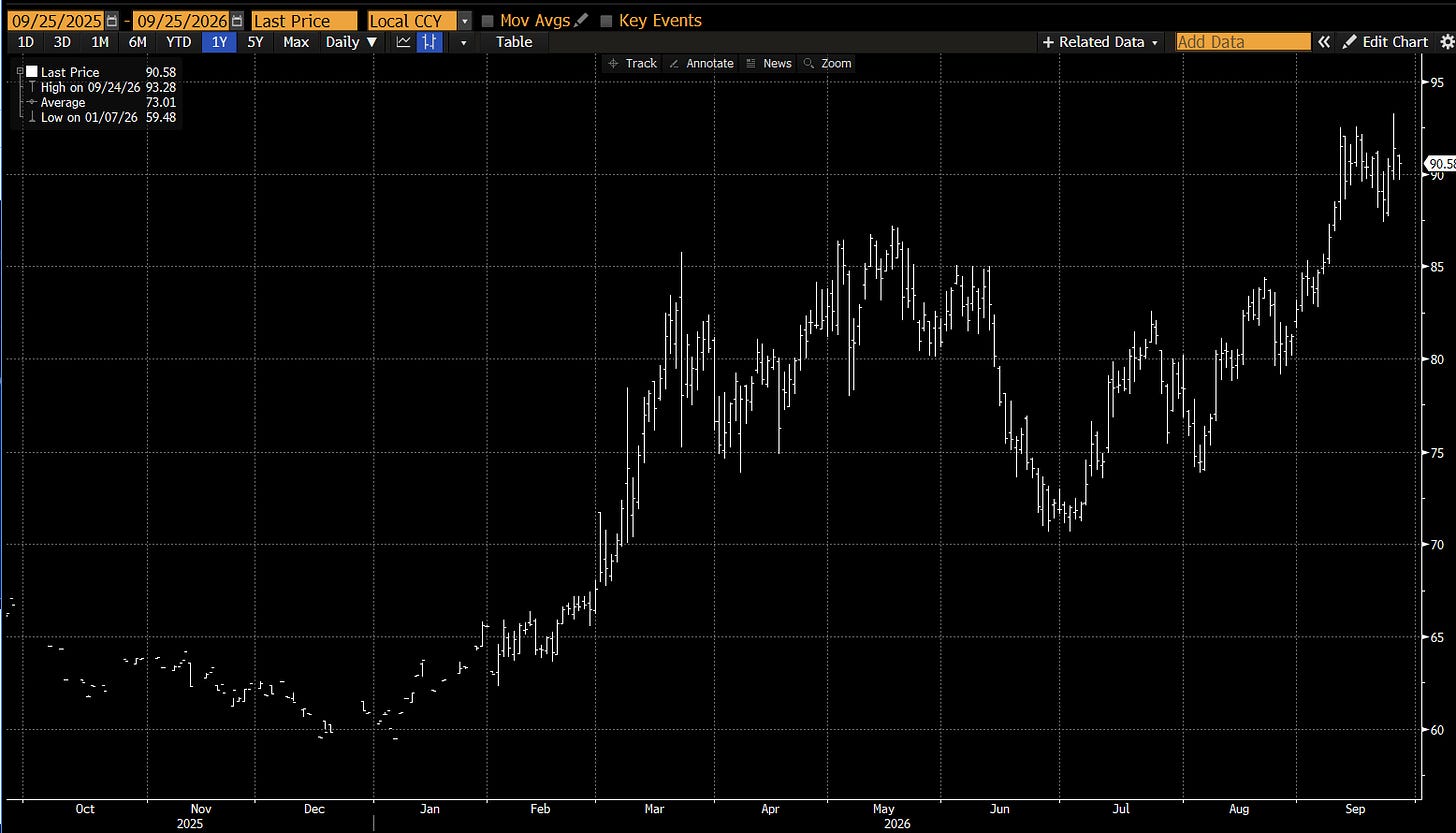
Oil prices (below) continue to rise, and the market has caught on to the fact that the White House is not what I would describe as an accurate reporter. On Thursday Reuters released a report based on “sources close to negotiations” that the Iranians were discussing opening up the Strait, less than 24 hours after Tehran reportedly blew up a boat. Oil sold off for about an hour, then went right back up. Said differently, verbal intervention is not working as well as it once did.
-
It is harder to parse the Iranian stance, but based on public statements, they have not appeared to shift their objectives since May, at which time they demanded an immediate end to hostilities, no immediate limits on enrichment, and hundreds of billions of dollars for war reparations. Given this, I don’t see how a deal gets done and the pressure on oil prices eases, though I am open-minded to some back-channel deal that I can’t see.
-
No one of these factors, so far, has undermined the mighty US stock market, which for several years continues to churn out amazing returns. Earnings are indeed strong. However, the risks have risen. Any further increase in bond yields will incentivize investors to own bonds versus stocks, and if AI wobbles even a little, there could be a re-evaluation of earnings momentum. Below are US real yields, up quite a bit, including this past week.