
Substack Library
GlossaryStorm Systems
October 22, 2026Not investment advice.
We are in the early stages of a turbulent storm system with three vectors.
The primary force is liquidity tightening amid an increase in issuance. The evidence is:
-
central bank rate hikes (so far there have been 16 quarter-point rate hikes within the G20)
-
market prices (falling), and
-
large government deficits, plus private-sector debt and share issuance (like CoreWeave bonds and the SpaceX IPO).
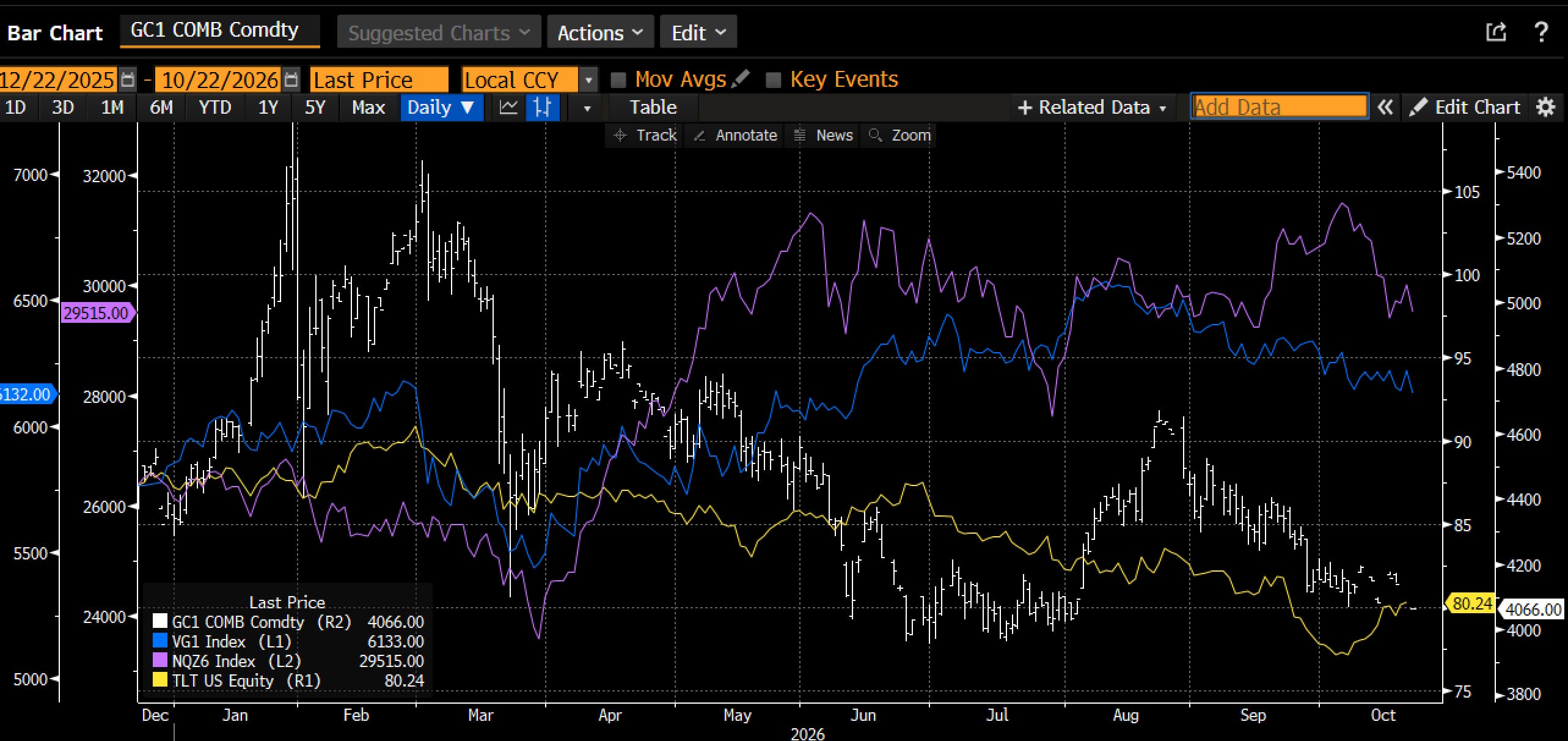
The gradual tightening against a backdrop of increased asset supply pulls down one asset after another. First it was gold, then bonds, then foreign stocks, then US corporate credit, and now US stocks. The chart below shows the sequence: gold fell first (white line), then bonds (yellow line), then European stocks (blue line), and now US stocks (purple line). This will continue until risky assets fall enough to slow growth, reduce inflation and force an easing. We are not close to that yet.
Within tightening liquidity, there is the AI substory. It is an article of faith that a) demand for compute is and will remain unlimited and b) supply is and will remain constrained. Every podcast, sell-side note and investor dinner treats these assertions as biblical truth. That’s reflected in market pricing, because markets are people, and people have a picture of reality in their heads. AI-linked companies that would normally trade at a P/E of 10 now trade at 17 or 18. They are fine companies, but they are priced on faith. Both articles of faith are wrong. While there are constraints today, they won’t last forever and can shift abruptly. The biggest users of compute are the frontier models, and it is not clear that their demand is unlimited. In fact, if creditors don’t give hundreds of billions to OpenAI soon, its demand will certainly slow markedly. This risk is not priced into the stocks that depend on that spending. Where will the money come from to propel more spending? Perhaps the US government, if keeping OpenAI around is considered essential for national security, which it might be. Why won’t data centers, like everything else, become more efficient? While all assets are under pressure, the breaking of these articles of faith means AI assets (the 18 P/E stocks that should trade at 10) are under more pressure.
A substory within this substory is the salesmanship of Musk and Huang. Both are superb salesmen who make wild assertions to rouse the faithful. To be sure, Teslas are cool, SpaceX rockets are cooler, and I’m told the Vera Rubin platform is fantastic. That said, if you look carefully, you can see through the shtick to the vulnerabilities in their arguments. If SpaceX doesn’t borrow more, it runs out of money in six months, yet Musk pitches its “total addressable market” as essentially the entire US economy. Huang asserts that demand for compute is “insatiable” and structurally infinite. But to make that come true, and to respond to competitive pressure from both Amazon and Google, he has tried to fund a separate ecosystem with OpenAI and CoreWeave to bolster demand for his chips. Demand will rise, but only because costs are coming down, and falling costs are not good for NVDA’s moat. Ditto cheaper Chinese electric cars versus Tesla, which is now promptly being folded into SpaceX. My point is that if the article of faith cracks even a little, prices will move a lot, even though the people selling to the faithful are really good at it and the underlying technology is powerful.
US policy is an additional vector. The fact pattern with the White House is that at each juncture where it can choose to de-escalate or escalate, it escalates. Tariffs were initially expected to be around 10%; instead, the White House went for 20% to 100%-plus. The border was supposed to be closed, and it was, but then the White House directed ICE agents to carry out forceful enforcement actions far from the border. Iran was supposed to be a surgical strike and has morphed into a protracted conflict. The January 6, 2021 gathering was supposed to be a rally and turned into a violent mob attack on the Capitol. If one applies the same template to the Nov. 3 election, the likely result is an effort to disrupt a vote the White House is forecast to lose. And this could happen amid a significant escalation in Iran.
These three fronts are coming together to create the storm. I am by nature an optimist, but at this juncture I am positioned for all three of these forces to get worse, not better.